Category Archives: Untitled 1980

A memoir. A collection of essays.

I do not know where I am going with this.

I wrote a long, rambling, weaving email to a friend of mine, and his reply was, “Apparently you are in the middle of a memoir… it reads well, so keep going.” So I thought I would.

The Free Library

I read a lot of books growing up — similar to most children, I suppose — pretty much any book I could get my hands on. The Boxcar Children, Encyclopedia Brown, anything. I had so many books I decided to start a library in my bedroom. I stacked the books neatly, created a library card and return slips with 3×5 index cards, and I invited my first customer into my room, my younger sister.

I am not sure which book she borrowed, but it was probably an Encyclopedia Brown, since following the thorough checkout process, she had returned to the library to borrow another book within an hour or two. (Encyclopedia Brown reads fast.)

I was caught off-guard and somewhat upset at the notion of a speedy return. I immediately established a new rule for a minimum borrowing time — that a book could not be returned within one day of checking it out — if only to validate the extensive effort of checkout. My sister thought that that idea was stupid, and that she wouldn’t borrow another book under such a rule.

The library folded later that day.

§ [insert_php] the_ID(); [/insert_php] · Originally published [insert_php] the_time(‘F j, Y’); [/insert_php].

Passing the EIT Exam

During the summers and winters while a student at Syracuse I worked for my hometown engineering department. It wasn’t the most difficult of jobs. Basically I drove a truck around town and watched all the construction projects going on, and I did do a good amount of surveying work, as well as some plan review in the office. In fact, I asked for a theodolite for Christmas, but never got one.

My last summer after graduating from Syracuse, and before I headed out to Berkeley for grad school, which I had never visited before (I went there on a whim; I had been to California once before, the previous spring), I had received the results of my EIT exam (formerly called the FE). The exam was a few months earlier on April 20. I remember because of the midnight celebration that surprisingly did not affect my early morning test-taking abilities. (They couldn’t have scheduled it for a more inconvenient day.)

I passed the exam, and I planned to tell my boss, the Town Engineer. He was a good guy, maybe early fifties, on his second marriage, with ties to the local mob. That is the hidden secret about Buffalo and her suburbs: the presence of the mob — however quiet — in daily life. The grocery store, the car dealership, and especially the construction companies, were mostly mob-run, or affiliated with the mob through family.

My colleague while working at the Town had his life threatened by construction workers when he made a stink about some of the work that they were doing. We were reviewing their building pad elevations with our trusty theodolite and the crew didn’t like the fact that we were on the site, let alone what we were doing. My colleague — his name was Marty Root, a son of a former powerful local politician, maybe twenty years older than I; a lost son of sorts, known for his past drunkenness; think of a young George W. Bush — filed a complaint about the incident, and I signed-off on it too. I didn’t think much of the incident when it happened, but I was a fan of the Sopranos, and I wasn’t the one being threatened.

My boss pulled me aside a day later and told me Marty was in the wrong, that we shouldn’t be reviewing the construction crew’s work, and to watch out for myself. The construction crew was part of the Cimato family, the head of which (Anthony) had emigrated to America from Italy decades earlier and made his fortune installing sewer in the northern suburbs of Buffalo. Tony started with nothing but took all the work he could (always submitting the low bid), and slowly but surely he made a lot of money, eventually owning his own business, and later he started a development company (with land that was given to him as payment for sewer work). One of his first neighborhoods was called Kingsview Estates, where I lived for the first twelve years of my life. My parents moved in a few months before I was born. My next door neighbor — the owners of the biggest house and lot in the neighborhood — was Tony Cimato, the developer himself. (Our house was tiny in comparison.)

I remember swimming in his pool with his college-age daughter Maria. There are photos that attest to this — Maria holding me in her arms in the pool — which is probably what started my youthful fondness for Italian women. My older sister (five years my senior) played with Tony’s youngest son, Francesco, around that time as well. Francesco grew up and took a role in the construction company his father built, the same company that was threatening my colleague at my summer job.

As my siblings and I grew older (and less adorable), the relationship between our neighbors and us sort of soured. At one point, we were told that we were no longer allowed to swim in their pool (it was one of the only pools in the neighborhood; my family usually went to the community pool to swim). My brother (sixteen months my elder) and I would play baseball and football in our backyard, and every now and then, an errant throw would wind up with the ball in their yard and behind their fence. We would climb the fence, a metal white picket fence, maybe five feet high with sharp points at the top, and get the ball, but they had a big scary black dog that frightened us (not a lab, possibly a Rottweiler that was chained to a big doghouse in their backyard), and we broke the top part of their fence once or twice. The mother was an old Italian woman and she did not like us young children climbing in her yard, and she would come out through the patio door yelling at us. (She looked like Mrs. Garrett from The Facts of Life, but more Italian and mean, like the chef from the Muppets.)

I bumped into Francesco once before on another construction site in town. The crew was installing concrete curb along a road that was eventually named Michael Douglas Drive. It was not named for the actor but for one of Tony Cimato’s grandchildren (or great grandchildren), as were many other streets being built in the residential neighborhoods in my town. Francesco didn’t recognize me, and I wouldn’t have recognized him if it weren’t for hearing someone call his name. He was the foreman for the curb installation job. Francesco was not on the other site when Marty was threatened with his life, an incident that Marty took much more seriously than I.

After Marty’s complaint was rejected, he told me that he would tell me all of the town’s secrets he knew, an unflattering account from all of his travails, secrets he knew because of his politically powerful family, including how the mob controlled construction in town and how they kept it that way. Marty and I never had the conversation as I was to depart to California, and never return, in a month or so.

I was sitting in my cube when I told my boss that I had passed the EIT as he walked from the reception area to his office, which was adorned with Republican memorabilia, including a photograph of him with then-President Ronald Reagan. My boss stopped and smiled, and said, “Well, that is like taking a shit.” And then he continued with more career advice. “And the PE — that’s like taking an even bigger shit.” He was right.

§ [insert_php] the_ID(); [/insert_php] · Originally published [insert_php] the_time(‘F j, Y’); [/insert_php].
Busted

Think Dr. Melfi, only much younger, like 24 or 25 years old. This was my therapy apparently. I could barely remember how I had gotten in trouble (and sentenced to therapy), but I was now glad that I had.

I tried avoiding the punishment. I let the answering machine pick-up, although I always did, no matter who the caller. I liked the fact that every caller was forced to listen to my outgoing message, the opening riff of Two of Us — “I ain’t dig a pygmy…” When I finally returned the call to the administrative office, the woman retorted, “Screening your calls, eh?” I didn’t really answer her sarcastic question; I didn’t think I had to. It was my freshman year at Syracuse. I was eighteen years old.

A month or so earlier, I had been caught smoking marijuana in my dorm room. I was with my girlfriend at the time, and my best pal Joe. The lesson is do not smoke joints (or blunts) in dorm rooms, because no matter what you do or how hard you try, the smoke and smell do not go away quickly enough. It’s the paper.
Continue reading Busted

The Iraq Option

Graduating from college, one always has options, some more enticing than others. I should already issue a correction: Unless your major studies were in the liberal arts and you did not have family connections, one always has options upon graduating from college, some more enticing than others. For me, one option was Iraq.

It was early 2003, and I was about to start the second semester of my graduate studies at the top school in the country for my program, the University of California at Berkeley. I was studying geotechnical engineering, and despite the fact that the economy was on the verge of exploding (in a positive way), engineering companies were hesitant in full-scale blanket hiring.

Enrollment in specialty graduate programs comes in waves. Typically during economic expansions marked by mass hiring, enrollment is low, and during economic recessions, marked by — at the very least — hiring freezes, enrollment is high. Two years after I graduated with a class of 25 (a relative high for the program historically), the school graduated a class of 8. School enrollment, especially voluntary enrollment like in graduate school, is directly related to national and global economic conditions, and it is routinely cyclical. Typically.

Job offers were not easy to come by for my class of twenty-five. When you were able to land an interview, you didn’t tell anyone else, because you were absolutely sure that they wouldn’t be reciprocating the courtesy. It was a fierce battle. Some of my classmates moved from the area chasing jobs. It was also the first time in more than a decade that companies didn’t pour-in through the front doors of the engineering building looking for talent, or that the professors’ phones weren’t off the hook with former colleagues looking for the next rising star, or so this is what our professors told us.

Instead of sorting through multitudes of offers, trading them with classmates like baseball cards, students had to fend for themselves. This led to a stressful last couple of months of school. It was custom for students to have jobs lined up in December, and now lining up a job for June was the most difficult assignment. This also served as a perfect example of free-market capitalism, forcing students to leverage their individual skills and political machinations, and also teaching not to spend too much energy on what may ultimately become a lost opportunity cost.

The invasion of Iraq began in March 2003, but the rumblings concerning the reconstruction, and the jobs that that would require, started much earlier. It was mid-January when I first got wind of the news. I had just returned from Buffalo, which I would not visit again for nearly six years, and my mouth was still sore. I had my wisdom teeth pulled while vacationing at home if only to ensure that the operation was covered by my parents’ insurance.

I was sitting in the computer lounge, surfing the internet for god knows what in the waning days of my final winter break, when a classmate informed that companies were looking to send engineers — hundreds of them — to Iraq to help re-build the country. Bechtel has a long history with the University, and they were one of the premier firms that were gearing up to land in Iraq once the short war was to be declared over. In what was to be the largest reconstruction project in the history of the world, San Francisco-based Bechtel was looking for engineers to send to the Middle East, especially young ones — those without families to care for, those that tend be take a little more risk in personal decision-making. You know, dumb college students. This is where I entered the equation.

The rumored offers were enticing: $200k, tax-free, plus no expenses. Engineers would work, eat and sleep on a campus built by Bechtel (and presumably protected by the U.S. Army, although at that time, this wasn’t a concern since the U.S. would be welcomed with open arms as an occupying force). The deal was to work for two years and return home with $400k in your bank account. I seriously considered this offer. How could any sane person not?

My memories of this potential offer to work in Iraq came rushing back while reading Confessions of an Economic Hit Man. In his memoir, John Perkins labeled large engineering and construction firms as a guiding force behind the corporate push for global empire (for the exclusive benefit of the United States). On more than one occasion, he specifically mentions Bechtel, although Bechtel was not the only engineering firm looking for debt-ridden engineering students to send and re-build the Middle East.

The offer was ultimately not for me. At the time, I doubted my decision to not pursue it further — to at least set-up an interview — since it seemed to be the perfect answer in an effort to pile-up some cash. I had a pretty girlfriend that I wanted to keep. I really enjoyed living in California and didn’t want to leave. And yes, I was scared. Eating in a mess hall with other young engineers would have been fun, but forgoing common sense that this assignment would be in a war-torn country, surrounded by known (and unknown) enemies of the state — of the country that I represent — would have been illogical. I realized this then, and I still realize this now.

I played it safe instead, and took a job locally. It wasn’t the six figures that an Iraq field-trip promised, but I left school with the highest starting salary in my class, and that wasn’t anything to look upon with regret.

Iraq was an option, and not all options are equal. I could have had a unique once-in-a-lifetime experience. I could have been a foreign contractor with a bulls-eye on my back. I could have come home with a pile of cash and an appetite for land. I could have come home in a body-bag. I believe I made the right decision.

§ [insert_php] the_ID(); [/insert_php] · Originally published [insert_php] the_time(‘F j, Y’); [/insert_php].

Dead, Home From Iraq, A Best Friend

My best friend in first and second grade has died. The obituary in my hometown paper — the esteemed Buffalo News — only says that Justin Reyes had “died unexpectedly” two-months-plus back. My parents informed me of the news — asking me if I knew the person — over a phone call two days ago. I told them, “Yes, in fact, he was my best friend in second grade.” Most likely, my friend committed suicide.

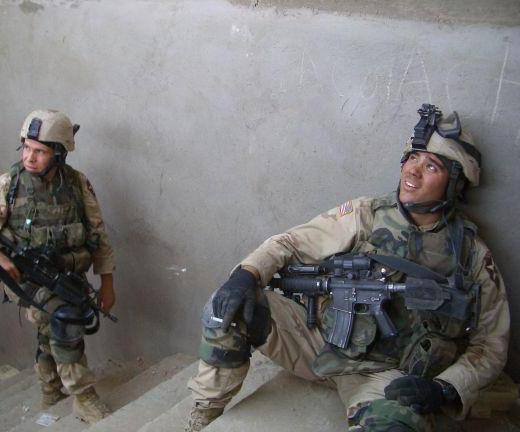
The paper mentions that Justin had “served in the U.S. Army for eight years, initially stationed along the DMZ in South Korea, and then deployed to Iraq during Operation Iraqi Freedom.” It adds that Justin “was the recipient of many commendation medals and awards for meritorious service as a Team Leader and Squad Leader for Charlie Company.” And, that Justin “sustained multiple combat related injuries and, as a result, retired in May 2007.”

Our friendship faded after second grade, not because of choice, but more so because at that age, friendship and even best-friendship was governed by your homeroom classmates (and neighborhood proximity). And as the years went by, and as our homerooms and neighborhoods remained distant, our childhood best-friendship became a friendship, and then just an acquaintanceship with a history. I remember randomly meeting Justin senior year in high school, and smoking some marijuana, laughing (of course) about how we used to play in the field and classroom of our elementary school, and now — well, all things come full circle. We graduated from high school together; I never saw or heard from him again.

Awhile back, I happened upon Justin’s MySpace profile (alright, I was MySpace lurking). I wanted to say “hello,” but thought that would be weird, so I didn’t, and now I wish I did. If I could go back in time, I would want to write this to him — in an email or a post on his wall or comment board — “Hey Justin, it’s me Jeff. How are you doing? I see that you fought in Iraq, I am glad that you are alright, safe at home. Although I am not an outward supporter of the war, I do most certainly support the troops, especially you. I love you to death.”

A photo on his MySpace profile shows my old buddy (on the right) in Ramadi:

Justin Reyes

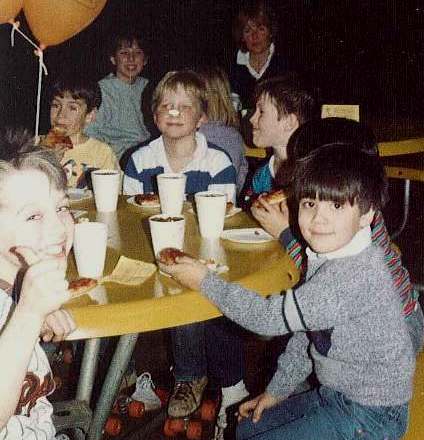
But I remember him from my (must-have-been) first-grade birthday party at the local roller skating rink, the best of the best places to have a party (that’s Justin, front and center, and my silly older brother to the left):

Justin Reyes

In second grade, Justin and I spent one week (when you’re young, a week is like a semester, and a summer is like a decade) shaving the colored coating off of all our pencils — yellow, red, blue, green — with our scissors (child-safety scissors, I am sure), resulting in pencils that were the color of the underlying wood. Our classmates all wanted them, and some even said they would pay for them (with what money, let’s just not think about that). Justin and I thought about starting a business with the apparent prospects of this bold venture. The student teacher even said he would like to use the shavings for his art projects (although he was most likely humoring us, as all second-grade student teachers tend to do). But there we had it, we were a zero-waste company in the making, based out of our desks in second-grade homeroom. (Of course, as fate would have it, “natural pencils” became all the rage, and the big guys would have pushed us out of the market anyway.)

In pace requiescat.

§ [insert_php] the_ID(); [/insert_php] · Originally published [insert_php] the_time(‘F j, Y’); [/insert_php].

2007 Summer Midseason Recap

The Superbas have started the second season in franchise history with a six-game losing streak. But the Superbas have lost with style.

The Superbas entered the second season with six new players, and a lineup that was improved across the board. But then the games started.

The Superbas opened the season with a 24-3 loss. And then followed that with a 21-9 loss. And then 20-4. And then 20-5.

It wasn’t until the sixth game that the Superbas’ bats finally came alive as a team. The Superbas eventually lost 18-15, but it was clearly the team’s best overall effort, and the game may be the turning point of a once-promising young season.

The Superbas have lost one of their stars. Utility fielder Dyelan Grace will miss the rest of the season following surgery on a torn Achilles tendon. D-Grace had become a major force at the plate and in the field.

Star pitcher and reigning MOP Carlo Quinonez has missed the entire season due to eligibility requirements. Quinonez is in the process of earning his GED and should be able to play the final three games. Additionally, last season’s clutch player, Jeff Adams, announced his surprise retirement after his wife gave birth to their first child.

The future always looks bright, but for the Superbas, the light could not be any brighter.